Meta, sections, inline + display math, a theorem, a numbered figure, and a cross-reference, in one document. (Citations are authored with <cite> + <library>; they resolve via the build / async render path, not shown live here — see issue #273.)
<meta type=article>
<title | On the Convergence of Iterative Maps>
<author | A. Researcher>
</meta>

<section #sec:intro | Introduction>

We study the fixed point of an iterative map $x_{n+1} = f(x_n)$. The displayed relation

<$$ #eqn:fix | x^\* = f(x^\*) $$>

defines the fixed point referenced throughout.

<section #sec:result | Result>

<theorem #thm:main | A contraction on a complete space has a unique fixed point.>

The schematic in <ref @fig:map> sketches the iteration, and equation <ref @eqn:fix> states the fixed-point condition.

<fig #fig:map src=iteration.png | The iteration approaching its fixed point.>
We study the fixed point of an iterative map
defines the fixed point referenced throughout.
A contraction on a complete space has a unique fixed point.
The schematic in figure 1 sketches the iteration, and equation equation 1 states the fixed-point condition.
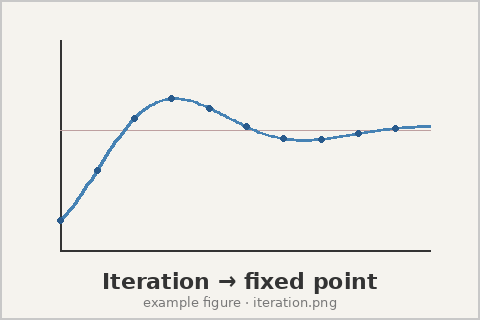
The iteration approaching its fixed point.
A definition, a list, a table, and a callout — the everyday block constructs together.
<section #sec:method | Method>

<definition #def:residual | The *residual* is the difference between observed and predicted values.>

The procedure has three steps:

<list ordered>
<li> Fit the model.
<li> Compute residuals.
<li> Inspect their distribution.
</list>

<table csv caption="Residual summary." |
stat,value
mean,0.01
sd,0.98>

<aside type=tip | Standardize residuals before comparing across models.>
The residual is the difference between observed and predicted values.
The procedure has three steps:
- Fit the model.
- Compute residuals.
- Inspect their distribution.
| stat | value |
|---|---|
| mean | 0.01 |
| sd | 0.98 |